![china-business-meeting-mock_2026-cl.jpg]()
Guidance on this subject tends to arrive as a list of principles. Respect hierarchy. Value relationships. Be patient. All true, and none of it tells someone walking into their first meeting in Beijing or Shanghai what to do with their hands when a business card is offered.
What follows is the mechanical version. Who is greeted first, where people sit, how a refusal is worded, when a glass commits you to something, and which gifts cause a problem.
The underlying principle is worth stating once, because it explains the rest. Most of what looks like formality is a way of establishing and protecting standing, both yours and your counterpart's. Once that is understood, the individual rules stop feeling arbitrary.
In short:
- The most senior person is greeted first, and seniority usually determines who speaks
- A direct "no" is rare, so listen for "maybe" and "we will consider it"
- Silence in a meeting is thinking time, not discomfort
- Lifting your glass during a toast can commit everyone at the table to emptying theirs
- Gifts are normal, but several common items carry unfortunate associations
- Warm hospitality is not confirmation, and being left alone is not rejection
Before the Meeting
Who Attends, and Why It Is Settled in Advance
Chinese counterparts generally expect the seniority of the two sides to match. Sending a junior manager to meet a company head reads as a signal about how seriously you take the relationship, whatever your intention.
Confirm in advance who will attend from their side and their titles, and match it as closely as you can. If your most senior person cannot travel, saying so early is far better than leaving it to be noticed in the room.
Punctuality and What Arriving Early Signals
Arrive early rather than on time. Lateness of even a few minutes is read as a comment on how much you value the other party's time, and traffic in both Beijing and Shanghai is unpredictable enough that a comfortable margin is sensible.
The First Few Minutes
Greetings, Names and Titles
The most senior person present is greeted first, and everyone else in descending order. Handshakes are normal and tend to be lighter than a Western business handshake, often accompanied by a slight nod.
Use titles and surnames rather than given names. "Director Li" or "Mr Wang" is correct until you are invited to do otherwise, and the invitation may never come, which is not a sign of coolness. In Chinese naming order the surname comes first, so Wang Wei is Mr Wang.
Expect a few minutes of general conversation before business begins. Moving straight to the agenda reads as brusque.
Business Cards and WeChat
The card ritual is real, though less central than most guides suggest. Contact details are now commonly exchanged by scanning a WeChat code, and some counterparts, particularly younger ones, no longer carry printed cards at all.
Bring cards regardless, printed in English on one side and Simplified Chinese on the other. Present and receive with both hands, take a moment to read the card rather than pocketing it immediately, and place it on the table in front of you for the duration of the meeting. Do not write on someone's card in their presence.
Where the Meeting Happens
Venue carries more weight here than in many markets, for the same reason seating and seniority do. A room booked for the purpose signals that the meeting matters. A hotel lobby signals that it was arranged in a hurry.
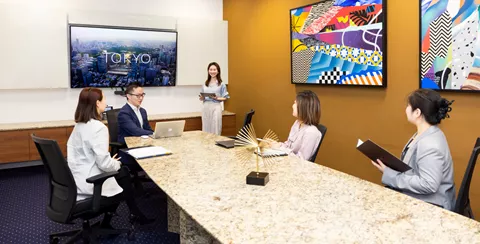
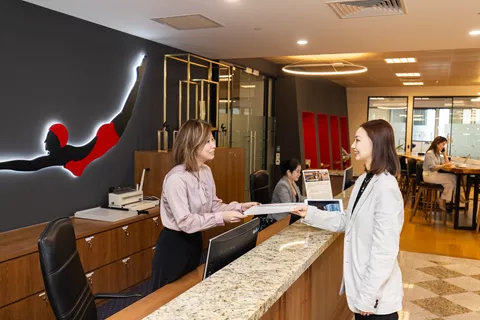
This is a practical problem for visitors whose company has no premises in China. Meeting at your counterparty's office is entirely normal and often preferable. When you need somewhere neutral, or you are hosting, meeting rooms and boardrooms can be booked by the hour in Beijing and Shanghai, in the districts where most international business sits. Servcorp has four addresses across the two cities with bilingual reception staff who receive guests by name, which removes the small awkwardness of meeting someone for the first time in an open lobby. The same logic applies to the address on your materials, as covered in why your business address matters in China.
Language and Being Understood
Assume less English than you expect. The people in the meeting may speak it well, particularly at senior levels in Beijing and Shanghai, while the people around it often will not. That gap matters more than the meeting itself, because contracts, follow-up correspondence and the practical arrangements all sit outside the room.
For a substantive negotiation or a technical discussion, arrange language support in advance rather than relying on an app. Bilingual secretarial support that includes translation covers the documents and correspondence around a meeting as well as the conversation in it, which is usually where the gap actually bites.
Inside the Meeting
Seating and Who Speaks
Wait to be shown where to sit. Position at the table reflects seniority, and choosing a seat yourself risks taking one intended for someone else. The most senior people generally sit centrally and opposite each other, with the rest arranged outward by rank.
Expect the senior person on their side to lead, and for others to contribute only when invited. Directing your questions to a junior colleague, however capable, can put them in an uncomfortable position.
How Disagreement Is Expressed
Direct refusal is uncommon, because it costs the other party standing and creates friction. "That is an interesting suggestion", "we will need to study this", "perhaps" and "it may be difficult" are all frequently a polite no.
The practical response is to notice when enthusiasm drops rather than waiting for a rejection that will not arrive. Ask what would need to change for the proposal to work, which gives them a way to tell you without refusing outright.
What Silence Means
Pauses are longer than many Western visitors find comfortable, and they are usually consideration rather than confusion or disapproval. Filling the silence with a concession is a common and expensive mistake.
Decisions are also frequently collective and taken after the meeting rather than in it, so several rounds are normal. Pressing for a commitment in the room rarely accelerates anything.
The Meal
Lunches and dinners are often where the substantive conversation happens, and treating them as social decoration around the real meeting misreads the situation.
Seating and Starting
Wait to be seated here too. The host usually orders for the table, and it is polite to let them. Begin eating when the host signals it, not before.
Who Pays
The host pays. Competing for the bill is a Western habit that does not travel well and can cause genuine discomfort. If you are hosting, arrange payment discreetly in advance.
Gifts, and the Ones to Avoid
Modest gifts representing your country or company are welcome and normal. Something distinctive from home works better than anything expensive, which can create obligation or raise compliance questions.
Several items carry associations worth avoiding. Clocks are linked to funerals through a similarity in the spoken language. Anything in sets of four is avoided for the same reason, four sounding close to the word for death. White flowers are associated with mourning, and a green hat carries a well known implication about a man's marriage.
Present and receive gifts with both hands. Do not expect the recipient to open it in front of you, and do not press them to. If your counterparts are government officials or work for a state-owned enterprise, check your own company's compliance rules before giving anything at all.
Reading the Signals Afterwards
Visitors frequently misread what happened. An elaborate banquet and a warm evening does not confirm a deal, and being left to your own devices after a short lunch does not mean it went badly. Both are common, and neither is a verdict.
The reliable signal is what happens next. Prompt, specific follow-up on their side generally means progress. Vagueness about next steps generally does not, regardless of how the hospitality felt.
Follow up quickly and in writing, ideally in both languages, summarising what was agreed and what you will do next. That is also the point at which a local contact who can handle correspondence and calls in Chinese earns their keep, since responsiveness in the days after a meeting counts for more than anything said during it.
Final Thoughts
None of this requires performance or pretending to be something you are not. It requires noticing who is senior, letting the host lead, listening for indirect refusals, and preparing the things that are easy to prepare, which are the venue, the language support and the follow-up.
Those are also the parts most visitors leave to chance. Getting them right is what makes a first meeting look considered rather than improvised.
Frequently Asked Questions